
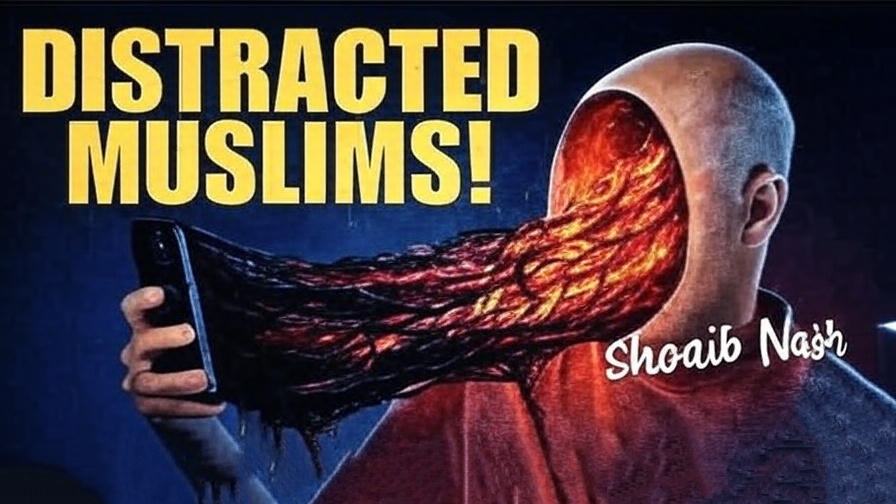
🌙 Why Muslims Are Stressed in 2025
Outline / Navigation
Part 1: Introduction & The Modern Age of Distractions
- Life in 2025: fast, noisy, stressful.
- Phones and social media addiction.
- Information overload = mental exhaustion.
- Losing focus on salah, Qur’an, family.
Part 2: Pressures Muslims Face in 2025
- Identity crisis: balancing Islam and modern life.
- Materialism & comparison culture.
- Religious neglect due to busyness.
- Global struggles & Islamophobia.
- The challenge of balancing dunya & deen.
Part 3: Psychological & Spiritual Effects
- Stress and anxiety symptoms.
- Weakening of imaan.
- Loss of barakah in time.
- Emotional disconnection in families.
- Mental & spiritual burnout.
Part 4: Warning Signs of Distraction
- Salah delayed or missed often.
- More time for screens than Qur’an or family.
- Feeling restless without the phone.
- Influencers shaping you more than scholars.
- Constant feelings of “not enough.”
Part 5: Islamic Perspective on Distractions
- Qur’an warnings about dunya.
- Being distracted as a test of life.
- Prophet ﷺ’s warnings about time and the Last Day.
- Where true peace really comes from.
Part 6: Practical Solutions for Muslims in 2025
- Protect salah at all costs.
- Digital discipline & screen-time control.
- Daily Qur’an habit.
- Dhikr & dua for calmness.
- Balance dunya & deen with time blocks.
- Stay in good company.
- Reconnect with family & ummah.
- Gratitude practice.
Part 7: Inspiring Examples
- The Prophet ﷺ: peace in chaos.
- Abu Bakr (RA): strength after loss.
- Umar (RA): simplicity brings peace.
- Modern student who chose Qur’an first.
- Busy professional who finds energy in salah.
Part 8: Conclusion — From Stress to Peace
- Stress will always exist, but faith gives tools.
- Anchor life in salah.
- Choose peace over distraction.
- Keep Qur’an & gratitude in daily life.
- Remember the akhirah is better & lasting.
- Final call: start with one small change today.
🌙 Why Muslims Are Stressed in 2025 (Part 1)
Introduction: A Heavy Question We All Feel
Bismillah. Let’s be honest.
Life in 2025 feels very different compared to even 10 years ago. Everywhere we go, we see people glued to their phones, rushing through life, chasing something… but not really finding peace.
Muslims, just like everyone else, are caught in this storm. But for us, the stress feels heavier because we are trying to balance two worlds:
- The dunya (this life), with its jobs, studies, money problems, and social media noise.
- The deen (our faith), with its prayers, Qur’an, family duties, and the call to prepare for the akhirah (hereafter).
The truth is, many Muslims today feel tired, distracted, and disconnected. The question is: why? And more importantly, what can we do about it?
This blog is not here to make you feel guilty. It’s here to have a heart-to-heart talk. To explain why stress has become such a big problem for Muslims in 2025, and to remind us of the way back to peace.
Part 1: The Modern Age of Distractions
1. Our Phones Have Become Our World
Let’s start with the obvious.
Most of us check our phones before we check in with Allah. The first thing in the morning is not “Alhamdulillah for waking up”, but: “Let me check my notifications.”
Think about how many hours you spend on:
- TikTok, scrolling endlessly.
- Instagram, comparing your life with others.
- YouTube, watching videos one after another.
- WhatsApp or Telegram, stuck in endless groups.
It feels small. Just “5 minutes.” But those 5 minutes multiply into hours. By the end of the day, we are drained. Not because we worked hard, but because we wasted our energy on things that gave us no benefit.
2. Information Overload = Mental Exhaustion
In the past, our grandparents lived simple lives. They didn’t know what was happening in 50 countries at once. They only knew their village, their neighbors, and maybe the next town.
But today? One scroll, and we see:
- Wars in one place.
- Celebrity gossip in another.
- A motivational quote.
- A fight on Twitter.
- An ad about something we don’t need.
Our brain is bombarded. No wonder we are stressed. We were not created to carry the whole world’s problems in our pocket.
3. Shifting Focus Away from What Matters
When we are drowning in distractions, what gets pushed aside?
- Salah is delayed.
- Qur’an is unread.
- Family time becomes “everyone on their own screen.”
- Duas are forgotten.
Slowly, we start feeling empty. We can’t explain why, but deep down, we know it’s because we are disconnected from the One who gives peace: Allah ﷻ.
💡 Reflection Question:
How many times did you delay salah this week because you were “busy” with your phone, work, or some random task?
🌙 Why Muslims Are Stressed in 2025 (Part 2)
Pressures Muslims Face in 2025
In Part 1, we spoke about distractions—phones, social media, endless scrolling—that eat away our time and energy. But distractions are only one piece of the puzzle.
Muslims in 2025 are not just distracted. They are also carrying heavy pressures that make life stressful. These pressures are unique because they affect both our dunya (worldly life) and our deen (faith).
Let’s look at some of them.
1. Identity Crisis: Who Am I Really?
Many young Muslims are confused. On one side, they love Islam. They know it is the truth. On the other side, the world around them pushes a very different lifestyle:
- Party culture.
- Dating.
- Drinking.
- “Be yourself, do whatever feels good.”
It’s like living with two voices in your head. One voice says: “Pray, be close to Allah, follow His guidance.” The other says: “Don’t be boring. Everyone else is having fun. You will miss out.”
This tug-of-war is exhausting. Some Muslims end up feeling like they don’t belong anywhere—not fully in Western culture, but also not fully practicing their faith. This identity struggle adds a lot of silent stress.
2. Materialism & Comparison Culture
Let’s be real. In 2025, life has become a competition of “who has more.”
- Who has the latest iPhone?
- Who drives a better car?
- Who travels more?
- Who has more followers?
Even if you don’t want to compare, social media makes you do it without thinking. You see someone’s “perfect” life online and suddenly your own life feels small.
But remember: what people show online is not the full picture. Behind those smiling photos may be depression, debt, or family fights. Yet still, we compare and feel stressed.
Allah reminds us in the Qur’an:
“Do not extend your eyes toward what We have given to some of them to enjoy. The splendor of this worldly life is only to test them. The provision of your Lord is better and more lasting.” (Surah Taha 20:131)
3. Religious Neglect
Because of busyness, many Muslims unintentionally neglect their deen.
- Salah is rushed or missed.
- Qur’an is left on the shelf.
- Duas are forgotten.
- Friday khutbahs feel like a routine, not a reminder.
At first, this neglect feels small. But over time, it creates guilt, stress, and distance from Allah. And when the heart is far from Allah, no amount of money, followers, or success can fill the emptiness.
4. Global Challenges & Islamophobia
Muslims are also stressed because of global issues:
- Wars and oppression in Muslim countries.
- Islamophobia and discrimination in non-Muslim lands.
- Negative media stories that make Muslims look bad.
Even if these problems are far away, they still weigh on our hearts. We feel the pain of the ummah. We feel powerless. This silent stress stays inside us, adding to the daily struggles we already face.
5. Balancing Deen and Dunya
Perhaps the hardest pressure is balance. Muslims know that Islam encourages working hard, studying, earning, and building families. But Islam also tells us: “Don’t forget your akhirah.”
In 2025, it feels like dunya is demanding 90% of our time—jobs, studies, bills, responsibilities. That leaves only 10% for deen. But the heart needs deen the way the body needs food. If we keep ignoring it, stress becomes our constant companion.
💡 Reflection Question:
Which of these pressures do you feel most in your own life—identity crisis, comparison, religious neglect, global struggles, or balance?
🌙 Why Muslims Are Stressed in 2025 (Part 3)
Psychological and Spiritual Effects of Stress & Distractions
In Part 1, we spoke about distractions.
In Part 2, we explored pressures Muslims face in 2025.
Now, let’s talk about what all of this actually does to us—our mind, our heart, and our soul.
Stress is not just “feeling tired.” It goes much deeper. It affects our thoughts, our sleep, our faith, and even the way we see life.
1. Stress and Anxiety Take Over
When your mind is always busy with notifications, comparison, and worries, your brain never rests. You may notice:
- Trouble falling asleep at night.
- Waking up tired even after hours of sleep.
- Feeling nervous for no clear reason.
- Overthinking small things.
- Having a constant “heavy” feeling in your chest.
Anxiety becomes like background noise—you don’t even notice it at first, but it’s always there.
2. Weakening of Imaan (Faith)
Our heart is like a lamp. It needs fuel to stay bright. That fuel is dhikr (remembrance of Allah), salah, Qur’an, and good company.
But when we fill our heart with endless distractions, the lamp begins to dim. Slowly, we notice:
- Salah feels like a burden instead of peace.
- Qur’an feels difficult to open.
- Sins feel easier, while good deeds feel heavy.
- We know Allah is watching, but we don’t feel close to Him.
This weak imaan adds even more stress. Because deep down, the soul is hungry. And when the soul is hungry, no amount of dunya can feed it.
3. Loss of Barakah (Blessing) in Time
Have you noticed how fast time flies now?
- You sit to check your phone “for 5 minutes”… suddenly 1 hour is gone.
- You plan to study for 2 hours… but after scrolling, you only did 20 minutes.
- You plan to pray on time… but after chatting, you realize you missed the salah.
This is the loss of barakah in time. The Prophet ﷺ warned us about a time when years will feel like months, months will feel like weeks, and days will feel like hours. We are living that reality now.
4. Emotional Disconnection
Another effect of this lifestyle is how we treat people.
- Families sit together, but everyone is on their own phone.
- Friends meet, but conversations are short because everyone wants to post online.
- Parents feel ignored by children.
- Spouses feel distant from each other.
This emotional disconnection makes life stressful. Humans were created to love, talk, and connect. When that is missing, loneliness increases—even if we have thousands of “followers.”
5. Mental and Spiritual Burnout
When we combine all of this—anxiety, weak imaan, wasted time, broken relationships—the result is burnout.
- We feel too tired to worship.
- Too busy to connect with people.
- Too drained to enjoy life.
This is why so many Muslims in 2025 feel restless. Not because Islam is heavy, but because the dunya has taken over our hearts.
💡 Reflection Question:
Do you feel your stress is more from outside pressures (like work, studies, society) or from inside pressures (like neglect of prayer, wasted time, or guilt)?
🌙 Why Muslims Are Stressed in 2025 (Part 4)
Warning Signs of Being Distracted
In Part 1, we spoke about distractions.
In Part 2, we saw the pressures Muslims face.
In Part 3, we looked at the effects on our mind, heart, and soul.
Now, let’s be very practical. How do you know if you are truly “distracted” by dunya?
Sometimes, we don’t realize it. We think, “I’m just busy” or “This is normal.” But if you look closely, there are clear warning signs.
1. Salah Keeps Getting Delayed or Missed
This is one of the biggest red flags.
- You are on your phone… adhan comes… you think, “I’ll pray later.”
- Work or studies make you delay salah again and again.
- Sometimes, you miss it completely and feel nothing inside.
When dunya takes priority over salah, it means distraction has entered the heart. Remember: Salah is supposed to be the relief from stress, not another item on your to-do list.
2. Screens Get More Time Than Qur’an or Family
Ask yourself:
- How many hours do you spend scrolling in a week?
- How many hours do you spend with Qur’an?
- How many hours do you sit with family without phones in hand?
If the screen wins every time, that’s a warning sign.
The Prophet ﷺ said: “The best of you are those who are best to their families.” (Tirmidhi)
But many of us are more kind and present with strangers online than with the people living in our own home.
3. You Feel Restless Without Your Phone or Entertainment
Here’s a test:
- Put your phone away for 1 hour.
- Don’t check social media.
- Don’t watch anything.
Do you feel peaceful? Or do you feel restless, bored, even a little panicked?
If peace only comes when you are “connected,” it means distraction has controlled your heart. True peace should come from being connected to Allah, not WiFi.
4. Influencers Shape You More Than Scholars
Another sign is when Muslims look up to celebrities and influencers more than to scholars or people of knowledge.
- We copy how influencers dress, talk, and live.
- We trust their advice more than Qur’an and Sunnah.
- We spend more time watching them than learning our deen.
It doesn’t mean all influencers are bad. But if they shape our thinking more than Allah’s words, we are being led by dunya, not by deen.
5. Constant Feeling of “Not Enough”
Do you feel like:
- “I’m not smart enough.”
- “I don’t earn enough.”
- “My life is not good enough.”
This feeling often comes from constant comparison. Instead of being grateful for what Allah gave us, we look at what others have and feel empty.
This emptiness is a sign of distraction. Because when we are truly connected to Allah, even a little feels like enough.
💡 Reflection Exercise:
Take a notebook. Write down honestly:
- How many times you delayed salah last week.
- How many hours you spent online vs. with Qur’an.
- The last time you felt truly grateful without comparing yourself to others.
This small exercise will open your eyes.
🌙 Why Muslims Are Stressed in 2025 (Part 5)
The Islamic Perspective on Distractions
So far, we spoke about:
- Part 1: Modern distractions.
- Part 2: Pressures Muslims face.
- Part 3: The effects on our hearts and minds.
- Part 4: Warning signs of distraction.
Now, let’s step back and ask: What does Islam actually say about this problem?
The truth is, distractions are not new. Humans have always been tempted by dunya (worldly life). What is new in 2025 is just the form of distraction—phones, media, endless content. But the warning has always been there in Qur’an and Sunnah.
1. The Qur’an Warns Us About Dunya
Allah ﷻ tells us clearly that this world can deceive us:
“The life of this world is nothing but play and amusement. But the home of the Hereafter is far better for those who are mindful of Allah. Will you not then understand?” (Surah Al-An’am 6:32)
This ayah is powerful. It doesn’t say dunya is evil—it says dunya is temporary. Like a game. Like entertainment. Fun for a while, but not the real purpose.
2. Being Distracted is a Test
Allah also says:
“O people, the promise of Allah is true. So do not let the worldly life deceive you, and do not let the deceiver deceive you about Allah.” (Surah Fatir 35:5)
Notice two things:
- The world itself can distract you.
- Shaytan also whispers to make you forget Allah.
So when Muslims feel stressed and distracted in 2025, it’s not random—it’s part of the test of dunya.
3. Prophet ﷺ Warned About Time
The Prophet Muhammad ﷺ said:
“There are two blessings which many people waste: health and free time.” (Bukhari)
Think about this. We waste health by not caring for our body. We waste free time by spending it on useless things instead of salah, Qur’an, or even quality family time.
And later, when stress comes, we regret: “I wish I had used my time better.”
4. He Also Warned About Distractions Before Qiyamah
The Prophet ﷺ told us signs of the Last Day. One of them was that people will compete in building tall buildings, and life will become fast. Doesn’t that sound exactly like today? Skyscrapers everywhere. Days and months passing like minutes.
He ﷺ also said:
“From the signs of the Hour is that knowledge will be taken away, ignorance will prevail, and fitnah (trials) will increase.” (Bukhari, Muslim)
In 2025, we see this clearly: endless information but little true knowledge; so much entertainment but little remembrance of Allah.
5. Where True Peace Comes From
Despite all the warnings, Islam also gives us the solution:
“Verily, in the remembrance of Allah do hearts find rest.” (Surah Ar-Ra’d 13:28)
This is the secret. Peace is not in the next Netflix episode. Not in the next iPhone. Not in more followers. Peace is only in connection with Allah.
💡 Reflection Question:
When was the last time you felt true peace? Was it during salah? Qur’an recitation? A moment of sincere dua? Or was it when you bought something or scrolled online?
Be honest with yourself. That answer will show you where your heart really finds rest.
🌙 Why Muslims Are Stressed in 2025 (Part 6)
Practical Solutions: How Muslims Can Reduce Stress and Fight Distractions
So far, we have understood:
- The distractions (Part 1)
- The pressures (Part 2)
- The effects (Part 3)
- The warning signs (Part 4)
- The Islamic perspective (Part 5)
Now, let’s talk about solutions. Because Islam never leaves us with a problem without guidance. Stress is real. Distractions are real. But there are ways to handle them.
Below are simple, practical steps Muslims in 2025 can take. These are not “big overnight changes.” They are small habits, but they make a huge difference if done consistently.
1. Protect Your Salah at All Costs
- Make salah your anchor. Fix it, then build your life around it.
- Plan your work, studies, and outings around prayer times, not the other way around.
- Use adhan apps to remind you.
- Don’t delay it for “just one more video” or “just one more email.”
💡 Tip: After every salah, sit for just 2 extra minutes. Do tasbeeh (SubhanAllah, Alhamdulillah, Allahu Akbar). Breathe. This small pause calms the heart.
2. Digital Discipline: Control the Phone Before It Controls You
- Set daily screen-time limits.
- Delete apps that waste your time.
- Keep your phone away during salah, Qur’an, meals, and family time.
- Have at least 1 “phone-free hour” every day.
💡 Tip: Replace random scrolling with something beneficial—listen to Qur’an recitation, Islamic podcasts, or lectures instead.
3. Daily Qur’an Connection
Even if it’s only one page a day, make Qur’an part of your routine.
- Morning: start with even 5 minutes of recitation.
- Evening: read or listen before sleeping.
- Reflect on just one ayah each day.
The Prophet ﷺ said: “The one who is proficient in reciting the Qur’an will be with the noble, righteous scribes (angels). And the one who reads it and struggles, finding it difficult, has two rewards.” (Bukhari, Muslim)
So even small effort is rewarded big.
4. Dhikr & Dua for Inner Calm
When stress rises, remember Allah. Simple words like:
- SubhanAllah (Glory be to Allah)
- Alhamdulillah (All praise to Allah)
- La ilaha illallah (No god but Allah)
- Allahu Akbar (Allah is Greatest)
The Prophet ﷺ told us these words are more beloved to Allah than everything the sun rises upon. (Muslim)
💡 Tip: Instead of reaching for your phone when bored, try doing dhikr quietly. You’ll feel the calm within minutes.
5. Balance Deen and Dunya with Time Blocks
Stress comes when we mix everything. Instead, block your time:
- Work/Study Block → focus only on your task.
- Worship Block → salah, Qur’an, dhikr.
- Family Block → no phones, just connection.
- Rest Block → sleep, hobbies, exercise.
This way, dunya doesn’t eat up all your hours.
6. Good Company Matters
- Stay close to friends who remind you of Allah.
- Avoid gatherings that push you into sin or waste.
- Join study circles, masjid programs, or even online Islamic communities.
The Prophet ﷺ said: “A person is upon the religion of his close friend, so let one of you look at whom he befriends.” (Abu Dawood, Tirmidhi)
7. Reconnect with Family and Ummah
- Spend real time with family—eat together, talk, laugh, share.
- Help your parents. Serve them—it brings barakah.
- Care about the ummah. Make dua for Palestine, Syria, Yemen, and all Muslims. This builds empathy and reduces selfish stress.
8. Gratitude Practice
Stress often comes from focusing on what we don’t have. Shift focus to what you do have.
- Every night, write down 3 things you are grateful for.
- Say Alhamdulillah with your heart, not just your tongue.
Allah promises: “If you are grateful, I will surely increase you [in favor].” (Surah Ibrahim 14:7)
💡 Reflection Exercise:
Choose two habits from above and start them today. Keep them for one week. Watch how your stress begins to reduce.
🌙 Why Muslims Are Stressed in 2025 (Part 7)
Inspiring Examples: Muslims Who Overcame Stress and Distractions
So far, we talked about problems, effects, and solutions. But sometimes, what really touches the heart is a story. Because when we see how others handled stress and distractions, we realize: “If they could do it, so can I.”
Here are some inspiring examples—from the time of the Prophet ﷺ, the Sahabah, and even Muslims in our time.
1. The Prophet Muhammad ﷺ: Calm in the Middle of Chaos
Imagine the stress he faced:
- People insulting him.
- Leaders plotting to kill him.
- Battles against huge armies.
- Poverty and hunger.
Yet he ﷺ never lost his inner peace. How?
- He prayed at night, crying to Allah.
- He remembered Allah in every moment.
- He trusted Allah completely.
When stress surrounded him, he didn’t rush to dunya—he rushed to salah. He used to say to Bilal (RA): “O Bilal, give the call to prayer. Bring us comfort through it.” (Abu Dawood)
This shows us: salah is not a burden, it is a refuge.
2. Abu Bakr (RA): Carrying Heavy Responsibility with Faith
When the Prophet ﷺ passed away, the ummah was in shock. People cried, some couldn’t believe it, and some even thought Islam would collapse.
But Abu Bakr (RA) stood up with calm strength and said:
“Whoever worshipped Muhammad, know that Muhammad has died. But whoever worships Allah, know that Allah is Alive and never dies.”
These words gave hope to the Muslims. Even in his pain, he reminded everyone to focus on Allah, not dunya.
Lesson: When stress feels overwhelming, anchor your heart in Allah—the One who never dies, never disappears, and never changes.
3. Umar ibn Al-Khattab (RA): Simplicity Reduces Stress
Umar (RA) was a powerful leader. He controlled an empire. But his lifestyle was simple:
- His clothes were patched.
- His food was plain.
- He slept under a tree without guards.
People asked him, “You rule such a big empire, but you live so simple?” He replied:
- “If I wanted, I could live in comfort. But I choose to live simply so I can focus on my duties.”
Lesson: Many times, stress comes from chasing too much dunya. Simplicity brings peace.
4. Modern Example: A Student Who Chose Qur’an First
Let’s fast forward to today.
A university student in 2025 shared this story online:
“I used to delay salah for classes and assignments. My stress was unbearable. One day, I promised myself: no matter what, I will pray on time. At first, it was hard. But slowly, I noticed something strange—my work got done faster, my mind was calmer, and my grades improved. I realized that when you give Allah His right, He puts barakah in your time.”
Lesson: Stress reduces when Allah comes first.
5. Modern Example: A Busy Professional
A Muslim doctor once said:
“I work long shifts at the hospital. It’s exhausting. But the only thing that keeps me sane is salah. Even when I’m tired, I take a short break, pray, and suddenly I feel energy again. Patients think I’m strong, but my strength comes only from turning to Allah.”
Lesson: Salah is like charging your battery. The more stressed you are, the more you need it.
💡 Reflection Question:
Who inspires you the most—the Prophet ﷺ, the Sahabah, or ordinary Muslims today who choose faith over distraction? And why?
🌙 Why Muslims Are Stressed in 2025 (Part 8 — Final Part)
Conclusion: From Stress to Peace
We started this journey asking: “Why are Muslims so stressed in 2025?”
And along the way, we discovered:
- Part 1: Modern distractions eat our time and energy.
- Part 2: Pressures of identity, comparison, dunya, and global struggles make life heavy.
- Part 3: Stress weakens our imaan, steals our time, and disconnects us from people.
- Part 4: Warning signs show us when dunya is taking over—delayed salah, endless scrolling, restlessness without the phone.
- Part 5: The Qur’an and Sunnah warned us about these distractions long ago.
- Part 6: Islam also gave us clear solutions—salah, dhikr, Qur’an, time management, gratitude.
- Part 7: We saw inspiring examples, from the Prophet ﷺ to ordinary Muslims, who chose faith over stress.
Now the question is: What do we do with all this knowledge?
1. Accept That Stress Will Always Exist
Islam never promised a stress-free life. Even the Prophet ﷺ faced grief, pain, and pressure. The difference is: he ﷺ faced it with Allah in his heart.
So don’t expect to remove stress completely. Expect to handle it better with faith.
2. Anchor Your Day in Salah
Make salah the unshakable pillar of your routine. No matter what happens, protect it.
If you do this one thing right, you will notice stress slowly losing its grip.
3. Choose Peace Over Distraction
Every time you pick up your phone, ask yourself:
- “Is this bringing me closer to Allah, or just wasting my time?”
- “Is this helping me relax, or is it making me more stressed?”
Small choices build a peaceful life.
4. Keep Qur’an in Your Daily Life
Even if it’s a page, a verse, or just listening for 5 minutes. The Qur’an is medicine for the heart. Without it, the heart stays sick.
5. Practice Gratitude Daily
Every night, whisper: “Alhamdulillah for today.”
Thank Allah for even the small things—your breath, your health, your family, your faith. Gratitude shifts your heart from stress to peace.
6. Remember the Bigger Picture
This dunya is not the end. It’s just a test. The problems, the stress, the struggles—they are temporary.
What lasts forever is the akhirah. And the akhirah is shaped by what you choose to focus on today.
Allah ﷻ reminds us:
“And the Hereafter is better and more lasting.” (Surah Al-A’la 87:17)
Final Message to You
Dear reader, if you feel stressed and distracted in 2025, know this: you are not alone. Many Muslims feel the same. But also know this: you are not powerless.
You have the Qur’an. You have salah. You have the dua that can move mountains. You have the example of the Prophet ﷺ who faced greater stress than us all, but never lost his peace.
Take small steps. Pray on time. Read one page of Qur’an. Do dhikr when you feel anxious. Say Alhamdulillah often.
With these small actions, inshaAllah, your heart will feel lighter. Your stress will not control you. And your life will once again be filled with sakīnah—the peace that only Allah gives.
💡 Call to Action:
Don’t just read this series and move on. Choose one small change right now. Maybe it’s praying on time. Maybe it’s limiting your phone use. Maybe it’s opening Qur’an today. Whatever it is—start.
Because peace is not something you wait for. Peace is something you build, step by step, with Allah’s help.
Leave a Reply