
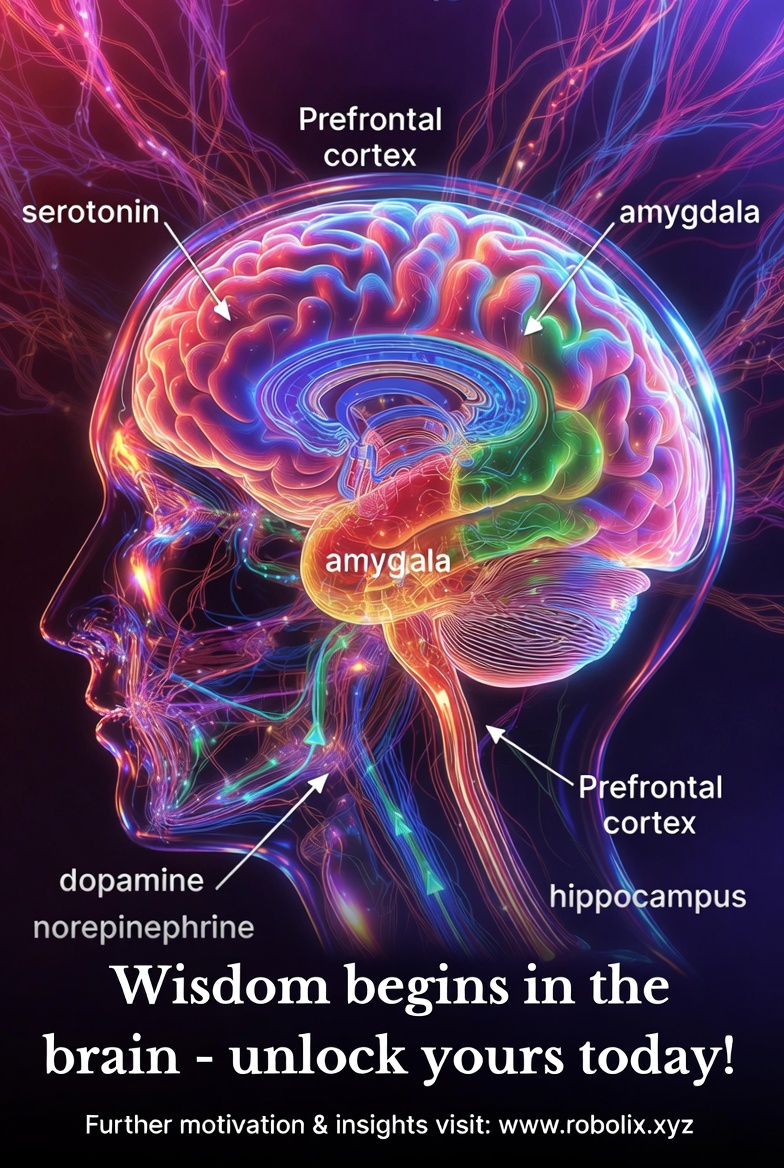
The Neurobiology of Wisdom
How Your Brain Builds Emotional Strength, Compassion, and Powerful Decision-Making
Introduction: Wisdom Is Not Magic — It Is Biology
Many people think wisdom comes from age, religion, intelligence, or suffering.
But modern neuroscience shows something powerful:
Wisdom is a brain skill.
It is built from:
- Emotional control
- Deep thinking
- Empathy
- Moral judgment
- Self-reflection
- Long-term vision
And all of this happens inside real brain circuits.
This means something revolutionary:
Wisdom is trainable.
You are not born wise.
You build it.
You wire it.
You strengthen it.
This article will show you:
- The brain regions behind wisdom
- The chemicals that shape behavior
- Why some people grow wiser and others grow bitter
- How trauma affects wisdom
- How to rewire your brain
- A complete 30-day Wisdom Rewiring Program
Everything will be explained in very easy English.
No complicated medical words.
Just deep truth made simple.
Part 1: The Brain Regions That Create Wisdom
Your brain is not one single thing. It is a team of different areas working together.
Wisdom happens when these areas are balanced.
1. The Prefrontal Cortex — The CEO of Your Brain
Location: Front of your brain (behind your forehead)
This area helps you:
- Control emotions
- Think before reacting
- Make moral decisions
- Plan long-term
- Stop impulses
If someone insults you and you stay calm — that is your prefrontal cortex working.
If someone shouts and you shout back instantly — your prefrontal cortex lost control.
Why This Matters
People with strong prefrontal control:
- Do not destroy relationships in anger
- Do not make fast emotional mistakes
- Think long-term
- Become leaders
Stress, trauma, lack of sleep, addiction — all weaken this area.
Solution: How to Strengthen It
- Daily meditation (10–20 minutes)
- Pause before responding in conflict (count 5 breaths)
- Journaling your emotions instead of reacting
- Sleep 7–8 hours
- Reduce constant phone stimulation
Every time you pause instead of reacting, you strengthen this brain region.
2. The Amygdala — Your Emotional Alarm
Location: Deep inside brain
This area:
- Detects danger
- Triggers fear
- Activates anger
- Creates fight-or-flight response
It is fast.
Very fast.
It reacts before logic.
If someone criticizes you and you feel attacked — that is your amygdala.
The Problem
If the amygdala controls your life:
- You become reactive
- You live in stress
- You damage relationships
- You fear change
Wisdom is not killing the amygdala.
Wisdom is calming it.
Solution: Calm the Amygdala
- Slow breathing (inhale 4 sec, exhale 6 sec)
- Cold water on face
- Naming your emotion (“I feel embarrassed”)
- Exercise
- Therapy for unresolved trauma
When the amygdala is calm, your higher brain can think clearly.
3. The Anterior Cingulate Cortex (ACC) — The Conflict Detector
This area:
- Detects emotional conflict
- Helps with empathy
- Allows flexible thinking
It helps you say:
“Maybe I am wrong.”
“Maybe they are hurting.”
Rigid people have weak flexibility here.
Wise people tolerate uncertainty.
Solution: Build Mental Flexibility
- Read opposing viewpoints
- Practice saying: “Tell me more”
- Debate respectfully
- Learn new skills often
- Travel or meet new cultures
Flexibility builds wisdom.
4. The Insula — The Empathy Center
This area helps you:
- Feel what others feel
- Sense your own body
- Understand emotional pain
People with strong insula activation:
- Show compassion
- Help others
- Build trust
Solution: Build Empathy
- Listen without interrupting
- Volunteer
- Ask: “How would I feel in their place?”
- Spend time with children and elderly
- Practice gratitude daily
Empathy makes wisdom human.
5. The Hippocampus — Memory and Meaning
This area:
- Stores experiences
- Connects past to present
- Learns lessons
Experience alone does not create wisdom.
Reflection creates wisdom.
Some people suffer and grow.
Others suffer and become bitter.
The difference is reflection.
Solution: Integrate Experience
- Weekly reflection journal
- Ask: “What did this teach me?”
- Forgive yourself for past mistakes
- Therapy or deep conversation
- Write your life story
Meaning transforms pain into wisdom.
Part 2: The Chemicals of Wisdom
Your brain runs on chemicals.
Balance creates calm.
Imbalance creates chaos.
Serotonin — Stability Chemical
When balanced:
- You feel calm
- You feel confident
- You are not easily triggered
Increase serotonin naturally:
- Sunlight
- Exercise
- Social connection
- Gratitude
- Healthy food
Dopamine — Motivation Chemical
Healthy dopamine:
- Drives long-term goals
- Supports discipline
Unhealthy dopamine:
- Addiction
- Constant scrolling
- Short pleasure seeking
Solution:
- Reduce instant gratification
- Work toward long-term goals
- Celebrate progress slowly
Oxytocin — Trust Chemical
This grows when:
- You hug
- You connect deeply
- You help others
It makes kindness rewarding.
Serve humanity and your brain rewards you.
Part 3: Why Some People Grow Wise and Others Don’t
Trauma and Stress
Chronic stress:
- Shrinks memory center
- Weakens emotional control
- Increases fear response
But trauma can also create growth.
The difference?
Processing.
Unprocessed pain becomes anger.
Processed pain becomes wisdom.
Neuroplasticity: Your Brain Can Change
Your brain rewires every day.
Every reaction builds pathways.
If you react with anger daily — anger becomes automatic.
If you pause daily — calm becomes automatic.
You are wiring your future personality right now.
Part 4: Practical Framework — The Wisdom Loop
Trigger
↓
Emotion rises
↓
Pause
↓
Reflect
↓
Empathy
↓
Wise action
Practice this loop daily.
Part 5: 30-Day Wisdom Rewiring Program
This is a full transformation plan.
Do it seriously.
Your brain will change.
Week 1: Emotional Awareness (Days 1–7)
Goal: Notice your emotions.
Daily:
- 10 minutes breathing meditation
- Label emotions 3 times per day
- No reaction for 5 breaths during conflict
- Journal before sleep:
- What triggered me?
- How did I respond?
- How could I respond better?
Result:
Awareness increases.
Reactivity decreases.
Week 2: Emotional Control (Days 8–14)
Goal: Strengthen prefrontal control.
Daily:
- Cold water face splash morning
- 20 minutes exercise
- Delay every impulse 10 minutes (snacking, scrolling)
- One difficult conversation handled calmly
Add:
- Reduce social media 50%
- Sleep 7–8 hours
Result:
Impulse control grows.
Confidence increases.
Week 3: Empathy Expansion (Days 15–21)
Goal: Activate compassion circuits.
Daily:
- One deep listening conversation
- One act of kindness
- Gratitude list (5 items)
- Reflect on someone who hurt you — try understanding them
Optional:
Volunteer once this week.
Result:
Bitterness reduces.
Connection increases.
Week 4: Integration & Wisdom Building (Days 22–30)
Goal: Become reflective and future-focused.
Daily:
- 20 min silent thinking time
- Write long-term life vision
- Identify repeating emotional patterns
- Practice “respond, don’t react”
On Day 30:
Write:
- Who was I 30 days ago?
- Who am I now?
- What will I never tolerate from myself again?
Final Message to Humanity
Wisdom is not rare.
It is not mystical.
It is not only for monks or old people.
It is a trained nervous system.
If humanity learns emotional regulation:
- Wars decrease
- Families heal
- Leaders improve
- Children feel safe
You do not change the world by shouting.
You change it by regulating your nervous system.
A regulated brain creates a peaceful society.
Start with yourself.
Train your brain.
Calm your amygdala.
Strengthen your prefrontal cortex.
Build empathy.
Reflect deeply.
And then watch how your life transforms.
This is not self-help.
This is self-rewiring.
And when enough people rewire their brains for wisdom —
Humanity will rise.
Leave a Reply