
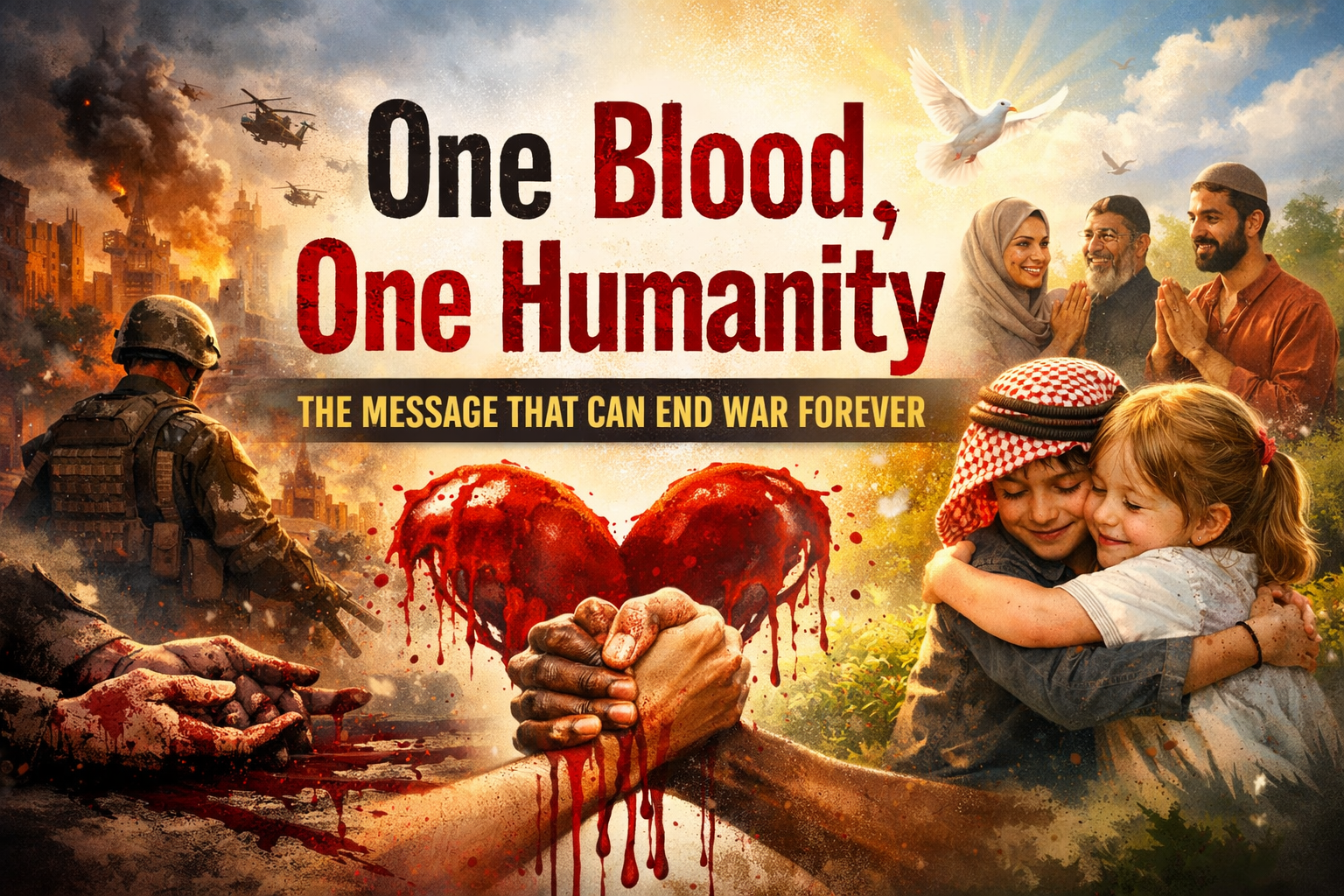
The Color of Blood Is the Color of Love
A Powerful Message to Humanity: How We Can End War Forever
Pause for a moment.
Place your hand on your chest.
Your heart is beating. Quietly. Patiently. Faithfully.
With every beat, blood moves through your body. Through your veins. Through your life.
That blood is red.
Now think about something beautiful:
Red is also the color of love.
So what does this mean?
It means something very simple and very powerful:
Inside every human being, love is already flowing.
A Muslim has red blood.
A Jew has red blood.
A Hindu has red blood.
A Christian has red blood.
An atheist has red blood.
Different languages.
Different cultures.
Different beliefs.
But the same blood.
The same life.
The same humanity.
And yet, something heartbreaking happens in our world.
Wars begin.
Cities burn.
Families break.
Children cry.
And that same red blood begins to fall on the ground.
When blood leaves the body in war, it feels like love is leaving the world.
Because every drop of blood that falls was once part of someone’s life.
Someone’s father.
Someone’s daughter.
Someone’s dream.
War is not just destruction of buildings.
War is the loss of human love.
So the real question is not only why wars happen.
The real question is:
How can humanity finally stop them?
This article is not about politics.
It is about human survival.
It is about building a future where our children do not grow up hearing bombs instead of birds.
And the truth is this:
War is not inevitable. War is a human decision.
And what humans decide, humans can also change.
The Painful Truth: War Has Never Truly Solved Human Problems
Throughout history, thousands of wars have been fought.
Empires rose and fell.
Borders changed.
But one thing remained the same:
Human suffering.
After every war, the world asks the same questions:
Why did this happen?
Could it have been avoided?
What did we really gain?
The painful truth is that war rarely solves the problem that started it.
Instead, it creates new problems:
• poverty
• trauma
• hatred between generations
• broken societies
• millions of refugees
War plants seeds of future wars.
Peace breaks that cycle.
Understanding the Real Roots of War
If we want to end war, we must understand its roots.
War is not born in battlefields.
War begins in human thinking.
Here are the deepest causes.
1. Fear of the “Other”
Humans sometimes fear people who look different, believe different, or live differently.
Fear creates distance.
Distance creates misunderstanding.
Misunderstanding creates enemies.
But when people meet, talk, and understand each other, fear begins to disappear.
2. Power and Ego
Some leaders believe greatness comes from control.
More land.
More influence.
More dominance.
But true greatness in history belongs to those who built peace, not those who destroyed cities.
3. Economic Interests
Many people do not realize this, but war is sometimes connected to money.
Weapons industries earn billions.
Conflict zones create economic opportunities for powerful groups.
This makes peace harder.
4. Historical Hatred
Sometimes wars continue because of wounds from the past.
One generation hurts another.
The next generation grows up angry.
Pain becomes tradition.
Breaking this cycle requires forgiveness and courage.
The Most Powerful Weapon Humanity Has
The most powerful weapon in the world is not nuclear bombs.
It is human empathy.
Empathy allows us to feel another person’s pain.
When empathy grows, violence becomes harder.
Empathy is the beginning of peace.
Real Solutions to End War
Ending war is not a dream.
It is a long process that requires action from governments, communities, and individuals.
Here are powerful solutions that humanity can implement.
1. Teach Peace Education in Every School
Imagine if every child in the world learned:
• emotional intelligence
• empathy
• conflict resolution
• cooperation
• cultural understanding
Instead of learning only history of wars, children should also learn history of peace.
Peace education can change the mindset of future generations.
2. Make Diplomacy the First Response, Not the Last
Too often, diplomacy begins after violence starts.
It should be the opposite.
Nations should invest heavily in:
• diplomatic relations
• mediation teams
• international negotiation experts
Talking early can prevent wars later.
3. Reduce Global Poverty and Inequality
Extreme inequality creates anger and instability.
When people lack basic needs like:
• food
• education
• healthcare
• opportunity
conflict becomes more likely.
A fair world is a more peaceful world.
4. Global Regulation of Weapons
The world produces enormous amounts of weapons every year.
Imagine if even half of that money was invested in:
• education
• renewable energy
• poverty reduction
• scientific research
Reducing weapons production can significantly reduce war intensity.
5. Promote Cultural Exchange Between Nations
When people travel, study abroad, and experience other cultures, something magical happens.
They realize that people everywhere want the same things:
• safety
• happiness
• family
• dignity
Friendship between cultures builds bridges that politics cannot destroy.
6. Encourage Responsible Leadership
Leaders must be held accountable.
Citizens should support leaders who prioritize:
• diplomacy
• human rights
• peace building
The character of leaders influences the fate of nations.
7. Use Technology to Connect Humanity
The internet allows humans to communicate instantly across the planet.
Instead of spreading hate, technology can be used to:
• promote dialogue
• share human stories
• organize peace initiatives
Technology can become a tool for global understanding.
8. Strengthen Global Cooperation
Humanity now faces shared challenges:
• climate change
• pandemics
• economic instability
• environmental destruction
These problems require global cooperation, not war.
The more nations cooperate, the less reason they have to fight.
9. Support Peace Journalism
Media plays a powerful role in shaping public thinking.
Peace journalism focuses on:
• solutions instead of conflict
• human stories instead of propaganda
• understanding instead of division
Responsible media can calm tensions instead of inflaming them.
10. Build a Culture of Dialogue
Conflicts will always exist between humans.
But violence is not the only way to resolve them.
Communities should develop systems of dialogue where disagreements can be discussed peacefully.
The Responsibility of Every Human Being
Ending war is not only the job of governments.
It is also the responsibility of ordinary people.
Every person can contribute to peace.
You can:
• challenge hatred when you see it
• speak respectfully with people who disagree
• learn about other cultures
• support humanitarian organizations
• raise children with compassion
Peace begins in small everyday actions.
Imagine a Different World
Imagine waking up in a world where:
No child hides from bombs.
No mother waits for news from a battlefield.
No city fears destruction.
Instead:
Children run through parks.
Students focus on dreams.
Countries compete in science, art, and innovation — not destruction.
This world is possible.
But it requires a change in human thinking.
The Simple Truth Humanity Must Remember
Inside every human body flows the same red blood.
It does not belong to one religion.
It does not belong to one nation.
It belongs to life itself.
When that blood spills in war, humanity loses a piece of itself.
But when humans choose understanding, compassion, and cooperation, something beautiful happens.
Love begins to win.
The Final Message to Humanity
One day, future generations will look back at our time.
They will see our technology, our intelligence, our achievements.
And they will ask one question:
“If humans were so advanced, why did they still fight wars?”
Let us make sure the answer becomes:
“Because humanity had not yet learned that every human life carries the same red blood and the same love.”
The day we truly understand this truth, war will begin to disappear.
Until that day, remember:
Inside every vein flows red blood.
Inside every drop lives love.
And love — when humanity finally chooses it — will always be stronger than war.
Leave a Reply