
The Neuroscience of Gratitude
How Thankfulness Rewires Your Brain, Heals Your Body, and Changes Your Life
Introduction: Gratitude Is More Than a Feeling
Most people think gratitude is just saying “thank you.”
But science shows something much deeper.
Gratitude is not just a feeling.
It is a mental habit.
It is a brain-training practice.
Every time you feel or express gratitude, your brain physically changes.
Yes — your brain actually rewires itself.
This means:
- Your thoughts change
- Your emotions change
- Your behavior changes
- Your life direction changes
So gratitude is not soft or emotional only.
It is powerful. It is biological. It is real.
What Happens in Your Brain When You Feel Gratitude?
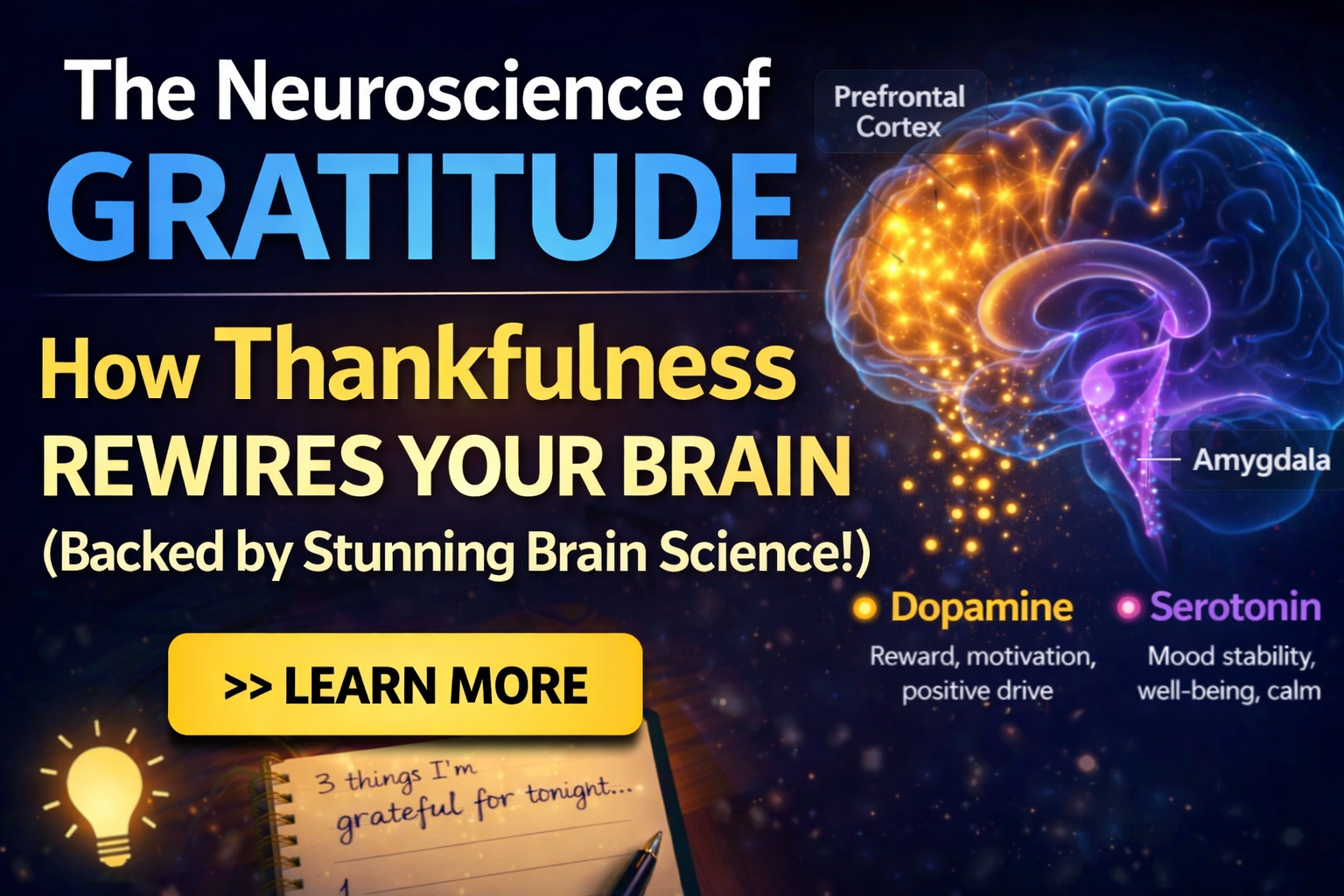
Let’s break down what the image is showing — and expand it clearly.
1. The Brain’s Chemical Response
When you feel gratitude, your brain releases two important chemicals:
Dopamine (The Reward Chemical)
- Makes you feel motivated
- Gives you a sense of reward
- Helps you want to repeat the behavior
So when you feel grateful, your brain says:
👉 “This feels good. Let’s do it again.”
Serotonin (The Mood Stabilizer)
- Improves mood
- Reduces anxiety
- Creates calm and balance
This is the same system many antidepressants target.
Important insight:
Gratitude naturally activates the same systems that medications try to support.
2. Brain Areas Involved
The image highlights two key parts of the brain:
Prefrontal Cortex
This is the “thinking brain.”
It controls:
- Decision making
- Focus
- Emotional control
- Self-awareness
Gratitude strengthens this area.
That means:
👉 You become calmer, wiser, and more controlled.
Amygdala
This is the “fear center.”
It reacts to:
- Stress
- Danger
- Anxiety
When you practice gratitude regularly:
- The amygdala becomes less reactive
- You feel less fear and stress
So you don’t just feel better —
👉 You become less sensitive to negativity.
3. Structural Changes in the Brain
This is where it gets powerful.
Gratitude doesn’t just change chemicals.
It changes brain structure.
What changes?
- Stronger connection between thinking brain and emotional brain
- Better emotional regulation
- Higher stress tolerance
- Reduced reactivity
Over time:
👉 Your brain becomes naturally calmer.
Not fake calm. Real calm.
4. The Biological Impact of Consistent Gratitude
The image also mentions physical effects on the body.
Let’s expand them.
Lower Cortisol (Stress Hormone)
- Less stress
- Less anxiety
- Better mental clarity
Reduced Inflammation
- Better immune system
- Lower risk of chronic disease
Improved Sleep
People who practice gratitude:
- Fall asleep faster
- Sleep deeper
- Wake up fresher
Better Heart Health
- Balanced heart rate
- Better circulation
Gut Health Improvement
There is a strong connection between:
👉 Brain ↔ Gut
Lower stress = better digestion.
5. The Most Powerful Finding
One simple habit:
👉 Write 3 things you are grateful for before sleep.
This creates measurable brain changes within DAYS.
Not weeks. Not months. Days.
Why?
Because repetition trains the brain.
Why Gratitude Works (Scientific Reasoning)
Let’s explain the deeper science in simple words.
The Brain Works on Focus
Your brain becomes what it focuses on.
If you focus on:
- Problems → you see more problems
- Fear → you feel more fear
- Gratitude → you see more good
This is called neuroplasticity
(the brain’s ability to change itself)
Gratitude Trains Attention
When you practice gratitude daily:
- Your brain starts scanning for good things
- You notice small positive details
- Your mindset shifts automatically
Emotional Conditioning
Every time you feel gratitude:
- Positive pathways get stronger
- Negative pathways get weaker
It’s like building a muscle.
Spiritual Benefits of Gratitude
Now let’s move beyond science.
Gratitude connects you to something bigger
When you feel grateful:
- You feel less empty
- You feel more connected
- You feel meaning in life
It reduces ego
Gratitude reminds you:
👉 “I am not in control of everything.”
This creates humility.
It brings inner peace
Gratitude shifts your focus from:
- What is missing
to - What is present
And peace lives in the present moment.
Religious Perspective on Gratitude
In Islam
Gratitude (Shukr) is a core concept.
The Quran teaches:
👉 “If you are grateful, I will give you more.”
Gratitude is shown through:
- Heart (feeling thankful)
- Tongue (saying thanks)
- Actions (using blessings properly)
In Christianity
Gratitude is central.
- “Give thanks in all circumstances.”
- Gratitude is linked with faith and trust in God
In Buddhism
Gratitude is connected with:
- Mindfulness
- Awareness
- Acceptance
Universal Truth
All religions agree:
👉 Gratitude leads to peace, growth, and blessings.
Why Most People Struggle With Gratitude
Let’s be honest.
It’s not that people don’t want to be grateful.
It’s that:
- The brain is wired for survival (not happiness)
- We focus more on problems
- We compare ourselves with others
- We chase more instead of appreciating what we have
Solution: How to Build a Gratitude Habit
Now let’s make this practical.
Step 1: Start Small
Don’t overthink.
Just write:
- One good thing today
That’s enough.
Step 2: Be Specific
Not:
- “I’m grateful for life”
Instead:
- “I’m grateful for the tea I had this morning”
- “I’m grateful someone smiled at me”
Specific = powerful
Step 3: Feel It (Not Just Write It)
Pause and actually feel gratitude.
Even for 10 seconds.
Step 4: Do It Daily (Especially at Night)
Best time:
👉 Before sleep
Because your brain processes it during sleep.
Step 5: Express It to Others
Tell someone:
- “I appreciate you”
This strengthens relationships and your own emotions.
Daily Gratitude Routine (Simple Plan)
Morning:
- Think of 1 thing you’re thankful for
Daytime:
- Notice small good moments
Night:
- Write 3 things you are grateful for
Weekly:
- Reflect on progress
Gratitude in Islam (Practical Guide)
- Say “Alhamdulillah” consciously
- Pray with awareness
- Help others
- Avoid complaining
Gratitude in Other Religions (Practice)
- Christianity: prayer of thanks
- Buddhism: mindful awareness
- Hinduism: gratitude through devotion
Final Truth
Your brain changes in the direction you train it.
If you train it with:
- Complaints → you become negative
- Gratitude → you become peaceful
Final Message
Gratitude is simple.
But it is not easy.
It requires:
- Consistency
- Awareness
- Practice
But once it becomes a habit:
👉 Your mind becomes lighter
👉 Your stress becomes lower
👉 Your life becomes richer
Not because everything changes…
But because you change.



Leave a Reply