
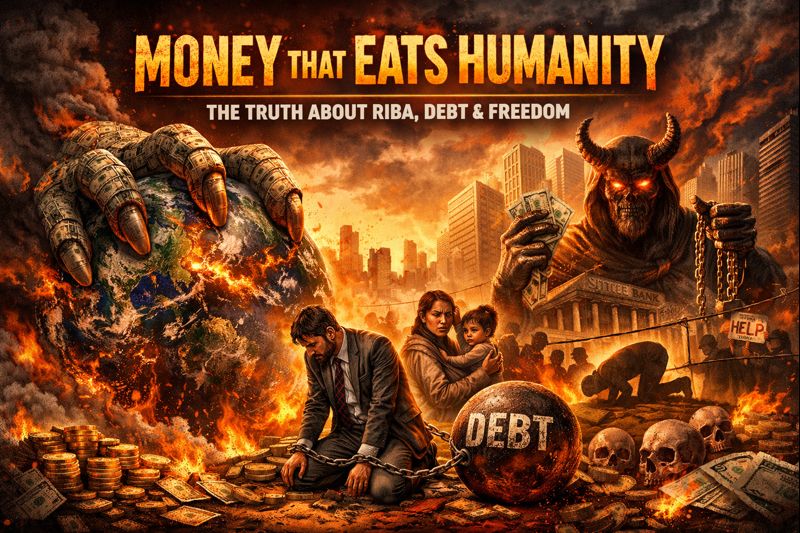
Riba-Free Mortgages, Loans & Insurance – Is It Possible?
A legacy article for humanity, written in simple words, for deep hearts
Introduction: A Question That Touches Every Human Life
Every human being wants peace.
Peace in the home. Peace in the heart. Peace when sleeping at night.
But today, millions of people sleep with a silent fear inside them — debt.
A debt that grows while they sleep.
A debt that does not care if they lose their job.
A debt that does not care if they fall sick.
A debt that does not care if their business fails.
This debt has a name. In Islam, it is called riba.
Some people translate riba as “interest,” but riba is more than interest. It is a system. A mindset. A way of thinking where money is allowed to grow without work, without risk, and without mercy.
This article is written for:
- The Muslim who is confused
- The non-Muslim who is suffering
- The student who is questioning
- The family trapped in loans
- The human being searching for justice
The question is simple, but the answer shakes the world:
Is it really possible to have mortgages, loans, and insurance without riba?
Let us begin — slowly, honestly, and with open hearts.
1. What Is Riba? Understanding the Root of the Problem
Riba is an Arabic word that means increase, excess, or growth.
In Islamic teaching, riba means:
Any guaranteed increase on money without real effort, real risk, or real value.
In simple words:
If money makes money by itself, without work, without risk — that is riba.
What the Qur’an Says
The Qur’an speaks very clearly about riba:
“Allah has allowed trade and forbidden riba.” (Qur’an 2:275)
Trade means:
- You work
- You take risk
- You may gain or lose
Riba means:
- You lend
- You relax
- You demand profit no matter what happens
Another verse shakes the soul:
“If you do not stop dealing in riba, then be warned of a war from Allah and His Messenger.” (Qur’an 2:279)
No other sin is described like this.
Not alcohol.
Not gambling.
Not theft.
Why?
Because riba destroys societies slowly but completely.
Types of Riba (Very Simple)
- Riba on loans – money lent with extra money demanded back
- Riba in trade – cheating through unfair exchange
Modern banking is built almost entirely on the first type.
Why Is Riba So Dangerous?
Because riba:
- Makes the rich richer
- Makes the poor poorer
- Punishes failure
- Rewards greed
- Removes mercy from money
Riba turns money into a master.
Human beings become servants.
2. Riba Is Not Only an Islamic Issue – It Is a Human Issue
Many people think riba is only a “Muslim problem.”
This is not true.
Christianity and Interest
In the Bible, it says:
“If you lend money to any of my people who are poor, you shall not be like a moneylender.” (Exodus 22:25)
For hundreds of years, Christians believed charging interest was a sin.
Churches banned it.
Judaism and Interest
The Torah says:
“You shall not charge interest to your brother.” (Deuteronomy 23:19)
Philosophers and Thinkers
- Aristotle said interest is unnatural
- Karl Marx said interest exploits workers
- Even modern economists admit debt-based systems cause crises
So ask yourself:
If prophets, philosophers, and human experience all warn us — why do we ignore them?
3. The Modern Financial System: A Silent Prison
Today, debt is normal.
We borrow to study.
We borrow to marry.
We borrow to buy a house.
We borrow to survive.
Banks create money from nothing.
Then they sell it back to us with interest.
If you succeed — they win.
If you fail — they still win.
This is not partnership.
This is control.
Families break.
Mental health collapses.
Nations drown in debt.
Yet we are told:
“This is the only way.”
Islam says:
“This is NOT the only way.”
4. Riba-Free Loans: Does Islam Offer an Alternative?
Yes. Islam does not only say “haram.”
Islam says: Here is a better way.
Qard Hasan – The Beautiful Loan
Qard Hasan means:
A loan given without interest, without benefit, without exploitation.
Allah says:
“Who is it that will give Allah a goodly loan, so He may multiply it for him?” (Qur’an 2:245)
This loan is not profit-based.
It is mercy-based.
In early Muslim societies, this was common.
Today, banks avoid it.
Why?
Because mercy does not maximize profit.
Profit and Loss Sharing
Islam says:
If you want profit — share the risk.
Mudarabah
One person brings money.
One person brings skill.
If profit comes — both share.
If loss comes — both feel it.
Musharakah
Both invest.
Both work.
Both risk.
This is justice.
But modern finance hates risk.
So it chooses riba.
5. Riba-Free Mortgages: Can You Own a Home Without Interest?
A home is not a luxury.
It is dignity.
Yet conventional mortgages turn homes into chains.
You buy a house for 300,000.
You pay back 600,000.
You pay for fear.
Islamic Home Financing Models
Diminishing Musharakah
- Bank and buyer own the house together
- Buyer slowly buys the bank’s share
- Rent decreases
Ijarah (Lease to Own)
- Bank buys the house
- Rents it
- Ownership transfers
The Painful Truth
Many so-called “Islamic” mortgages copy interest with Islamic names.
Scholars debate this.
Imam Ibn Taymiyyah said:
“Changing names does not change realities.”
We must be honest.
6. Riba-Free Insurance: Takaful Explained Simply
Insurance exists because humans fear loss.
Islam does not deny fear.
Islam denies profiting from fear.
Problems with Conventional Insurance
- Gambling-like uncertainty
- Interest-based investments
- Profit from disasters
Takaful – Mutual Protection
People contribute donations.
Losses are shared.
No one benefits from another’s pain.
It is community, not business.
But challenges remain.
7. Are Islamic Financial Products Truly Riba-Free?
This is the hardest section.
Some scholars say:
“This is the best we can do in today’s system.”
Others say:
“This is riba wearing halal clothes.”
Sheikh Taqi Usmani says:
“If risk is not shared, riba still exists.”
Truth requires courage.
8. What Other Religions and Ethical Movements Are Doing
Christian ethical banks exist.
Jewish free-loan societies exist.
Credit unions exist.
Humanity is waking up — slowly.
9. What Can You Do as an Individual?
You may feel small.
But intention matters.
- Learn
- Ask questions
- Avoid riba when possible
- Choose lesser harm when forced
- Support ethical alternatives
Allah judges effort, not perfection.
10. The Future: A World Beyond Riba
Technology can help.
Fintech.
Blockchain.
Community finance.
But technology without ethics is useless.
The real change begins in hearts.
Conclusion: A Final Message to Humanity
Riba-free finance is possible.
But it demands courage.
It demands choosing justice over ease.
This struggle is not Islamic only.
It is human.
And every human who reads this becomes responsible.
The question remains:
Will we continue serving money — or will money return to serving humanity?
The answer will define our future.
Leave a Reply