
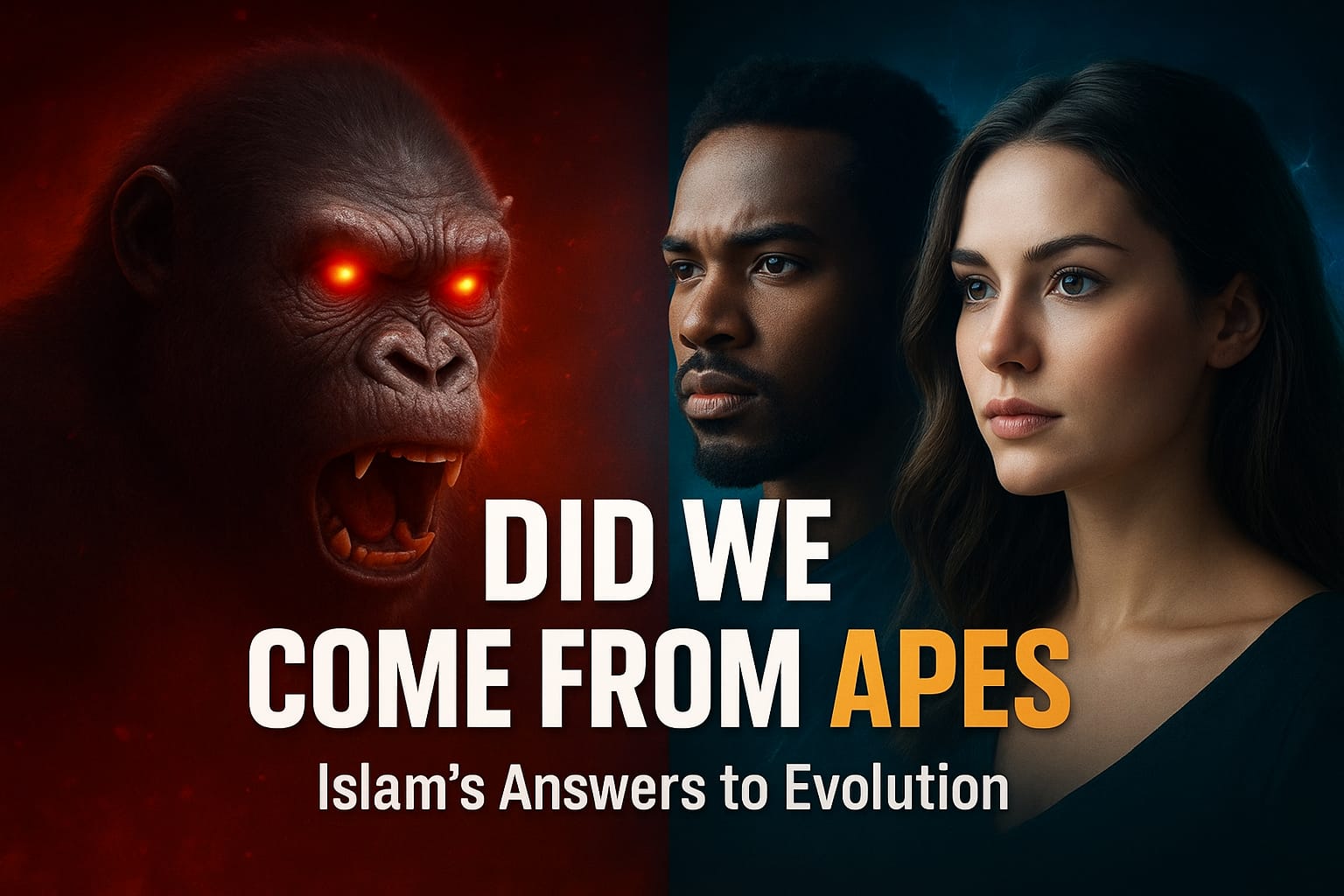
🧬 Did We Come From Apes? Islam’s Answer to Evolution
(A Complete Guide Combining Science, Faith, and Reflection)
🌍 Introduction
One of the biggest questions people ask today is:
“Did humans come from apes?”
This question touches both science and faith. It’s discussed in classrooms, mosques, documentaries, and debates all over the world. Some people believe that evolution fully explains human origins, while others believe that humans were created directly by God — as described in the Qur’an.
But what does Islam really say about human creation?
And what does modern science actually teach about evolution?
Let’s explore both sides carefully, using clear language and balanced reasoning, while keeping our hearts and minds open to truth.
🧠 Part 1: What Science Says — Understanding Evolution
1.1 What Is Evolution?
In simple words, evolution is the idea that all living things on Earth are related and have changed over a long time.
It means that species can change — they adapt, develop new traits, and sometimes even turn into new species after millions of years.
The main idea of evolution was first made famous by Charles Darwin in 1859, in his book “On the Origin of Species.”
1.2 How Does Evolution Work?
Evolution works through a few key processes:
- Natural Selection:
The “survival of the fittest.”
Animals with traits that help them survive and reproduce are more likely to pass those traits to their children. - Mutation:
Small changes in DNA that happen by chance. Sometimes these changes help survival; sometimes they don’t. - Adaptation:
Over time, these small changes can help species better fit their environment. - Common Ancestry:
This is the part that connects humans to apes. Scientists believe humans and apes share a common ancestor — not that humans “came from” apes, but that both evolved from an earlier species millions of years ago.
1.3 Evidence for Evolution
Science supports evolution through several kinds of evidence:
a) Fossil Record
Scientists have found fossils of ancient humans that show a gradual change from ape-like ancestors to modern humans — such as:
- Australopithecus afarensis (like the famous fossil “Lucy”)
- Homo habilis (“handy man”)
- Homo erectus (“upright man”)
- Homo neanderthalensis (Neanderthals)
- Homo sapiens (modern humans)
These fossils show increasing brain size and more advanced tools over millions of years.
b) Genetics
Human DNA is about 98–99% similar to chimpanzee DNA.
This doesn’t mean humans “came from chimps,” but it supports the idea of a shared ancestry long ago.
c) Comparative Anatomy
Our bone structure, muscles, and even certain organs are very similar to other animals. For example, the bones in a human hand and a monkey’s paw follow a similar pattern.
d) Embryology
When scientists look at the embryos of different animals (including humans), the early stages are very similar — another clue of shared ancestry.
e) Observed Evolution
Evolution isn’t just history — it happens today.
We see bacteria evolve to resist antibiotics, and insects evolve resistance to pesticides.
These are small (micro) examples of evolution happening in real time.
🧬 Part 2: Human Evolution in Science
According to scientists, humans belong to the species Homo sapiens, which appeared about 200,000–300,000 years ago in Africa.
But we are part of a larger “family tree” of primates that includes:
- Chimpanzees
- Gorillas
- Orangutans
- Gibbons
Scientists say humans and chimpanzees share a common ancestor that lived around 6–7 million years ago.
From that ancestor, different branches evolved — some became chimpanzees, and one branch eventually led to humans.
So, science does not say humans came from apes, but that both humans and apes share an ancient ancestor.
☪️ Part 3: The Islamic View — How the Qur’an Describes Human Creation
Now let’s look at what Islam teaches about how humans were created.
3.1 The Creation of Adam (peace be upon him)
In the Qur’an, Allah tells us that the first human was Adam (‘alayhi as-salām) — created directly by Allah, not evolved from any previous species.
“He created him from clay, then fashioned him and breathed into him of His spirit.”
(Surah As-Sajdah 32:7–9)
This means Adam was made from earthly materials (clay), but what made him truly human was the divine spirit that Allah breathed into him.
3.2 Adam and Human Dignity
Adam was not only the first man — he was chosen by Allah as the first prophet and the first khalifah (representative) of God on Earth.
“Indeed, I will place upon the earth a successive authority (khalifah).”
(Surah Al-Baqarah 2:30)
This shows that humans have a special purpose — we are not just animals, but spiritual beings with intellect, free will, and moral responsibility.
3.3 The Creation of Hawwa (Eve)
From Adam, Allah created his spouse Hawwa (Eve), and from them came all human beings.
“O mankind, fear your Lord, who created you from one soul and created from it its mate.”
(Surah An-Nisa 4:1)
So, in Islam, humanity begins with a divine creation, not with evolution from earlier species.
📖 Part 4: Islamic Scholars’ Views on Evolution
Not all Muslim scholars have had the exact same view. Over the centuries, scholars and modern thinkers have discussed this deeply.
We can divide opinions into three main categories:
4.1 The Literalist View (Traditional)
- Believes that Adam was created directly by Allah, as described in the Qur’an.
- Rejects any human evolution from apes or other species.
- Evolution may happen in animals or plants, but not in humans.
- Supported by many classical scholars like Ibn Kathir, Al-Tabari, Al-Ghazali, and many contemporary scholars such as Dr. Zakir Naik, Sheikh Yasir Qadhi, and Mufti Menk.
4.2 The Harmonizing View (Middle Ground)
- Accepts that evolution could be a natural process created by Allah for plants and animals.
- Believes that Adam’s creation was a special event — Allah directly created him, even if other life evolved.
- This view sees no contradiction between science and revelation, as both come from Allah.
- Supported by scholars like Dr. Yasir Nadeem al-Wajidi, Hamza Tzortzis, and some modern Islamic scientists.
4.3 The Allegorical or Symbolic View (Philosophical)
- Suggests that Qur’anic stories may use symbolic language to teach moral truths.
- “Adam” could represent the first spiritually conscious human, rather than the first biological man.
- This view is not mainstream but is discussed in modern Islamic philosophy.
🌿 Part 5: The Qur’an and Scientific Reflection
Islam strongly encourages studying the natural world:
“Indeed, in the creation of the heavens and the earth and the alternation of the night and day are signs for those of understanding.”
(Surah Al-Imran 3:190)
The Qur’an often invites believers to observe, reflect, and use reason.
So, studying biology, genetics, and even evolution can be seen as studying the signs (ayat) of Allah.
Many scholars say:
- Science explains how Allah created things.
- Revelation explains why He created them.
Both can exist together if we understand their roles correctly.
🔬 Part 6: Comparison Between Evolution and Islamic Belief
| Aspect | Scientific Evolution | Islamic Belief |
|---|---|---|
| Origin of Life | Life began by natural processes (biochemical evolution). | Allah created life directly. |
| Origin of Humans | Evolved from a common ancestor with apes. | Created directly as Adam and Eve. |
| Mechanism | Mutation, natural selection. | Divine creation and will. |
| Purpose of Life | No built-in purpose (in scientific view). | Humans are created for worship and moral responsibility. |
| Timeframe | Millions of years. | Not specified in Qur’an. |
| Human Uniqueness | Based on intelligence and social behavior. | Based on soul, reason, and divine spirit. |
This comparison shows that science and Islam talk about different levels of reality:
science describes the mechanism of creation, while Islam explains the meaning and purpose behind it.
💬 Part 7: Misconceptions About Evolution and Islam
7.1 “We came from monkeys”
This is incorrect.
Evolutionary theory says humans and monkeys share a common ancestor, not that one came from the other.
7.2 “Islam rejects science”
Completely false.
Islam actually encourages scientific study.
Muslim scholars of the Golden Age (like Ibn Sina, Al-Biruni, and Al-Khwarizmi) made huge contributions to science while holding strong faith.
7.3 “Evolution means there is no God”
Evolution describes a process — it doesn’t say who made the process.
Believers say: Allah created life through the laws He designed.
⚖️ Part 8: Can Islam and Evolution Coexist?
This question depends on how we understand both.
Many modern Muslim thinkers say there’s no real conflict as long as we keep faith in Allah as the ultimate Creator.
- Evolution could describe the process,
- But Allah is the One who made the process work.
Even if life evolved, it would still be Allah’s plan, not random chance.
But when it comes to Adam, most Muslims agree his creation was a unique miracle, not an outcome of evolution.
🌈 Part 9: The Spiritual Dimension
Science can explain the body, but not the soul.
The Qur’an says:
“And they ask you about the soul. Say, ‘The soul is of the affair of my Lord, and you have been given only a little knowledge.’”
(Surah Al-Isra 17:85)
This means human uniqueness lies not just in physical evolution, but in the spiritual soul that Allah gave us — something beyond biology.
🧩 Part 10: Education, Faith, and Balance
In Muslim societies, evolution is sometimes taught in schools as part of science.
This can confuse young Muslims if they think it denies God.
But it helps to understand: learning evolution is not the same as believing humans came by chance.
Students can study it as a scientific theory while maintaining belief in Allah’s creation.
Islam doesn’t fear knowledge — it welcomes it. The Prophet ﷺ said:
“Seeking knowledge is an obligation upon every Muslim.” (Ibn Majah)
So, Muslims should learn science, but always keep their faith strong and understand that Allah is behind all creation.
🌟 Conclusion
So, did we come from apes?
Science says: Humans and apes share a common ancestor.
Islam says: Allah created Adam directly, as the first human and prophet.
Both agree that humans are special — but Islam adds the spiritual truth: humans are created with a soul, reason, and moral purpose.
We can respect scientific study as the exploration of how Allah’s creation works, while still believing firmly in the why — that Allah created everything with wisdom.
In the end, both the scientist looking through a microscope and the believer reading the Qur’an are exploring the same universe, made by the same Creator.
Key takeaway:
- Islam does not reject science.
- Evolution may describe how life changes — but creation describes who designed life.
- Adam (peace be upon him) is a special creation of Allah — the father of all humanity.
- True knowledge comes from both the book of nature and the Book of Revelation.
Leave a Reply